

Countertops collect phone chargers like junk drawers collect takeout menus. One phone on the kitchen island becomes three cables, a tablet brick, and a watch charger — and the moment you see the phone, you’re checking it again. That’s the insight behind the hidden charging drawer trend: move the charging inside a drawer, close it, and the mess disappears along with the temptation. It’s been all over social feeds because it works on two levels — cleaner counters and calmer evenings.
Why this little project keeps going viral
The appeal is simple psychology. As DAP’s 2026 home-improvement roundup points out, moving your charging cables inside a drawer removes the visual trigger of seeing your phone while hiding the cord tangle too. Out of sight really is out of mind. At night you plug in, close the drawer, and a closed drawer says “put it down” far better than a glowing screen on the nightstand.
People are building these in kitchen junk drawers, bedside tables, and bathroom cabinets. The kitchen version works as a family landing pad for everyone’s devices; the nightstand version is the one that changes habits.
The two ways to power it (read this before you buy anything)
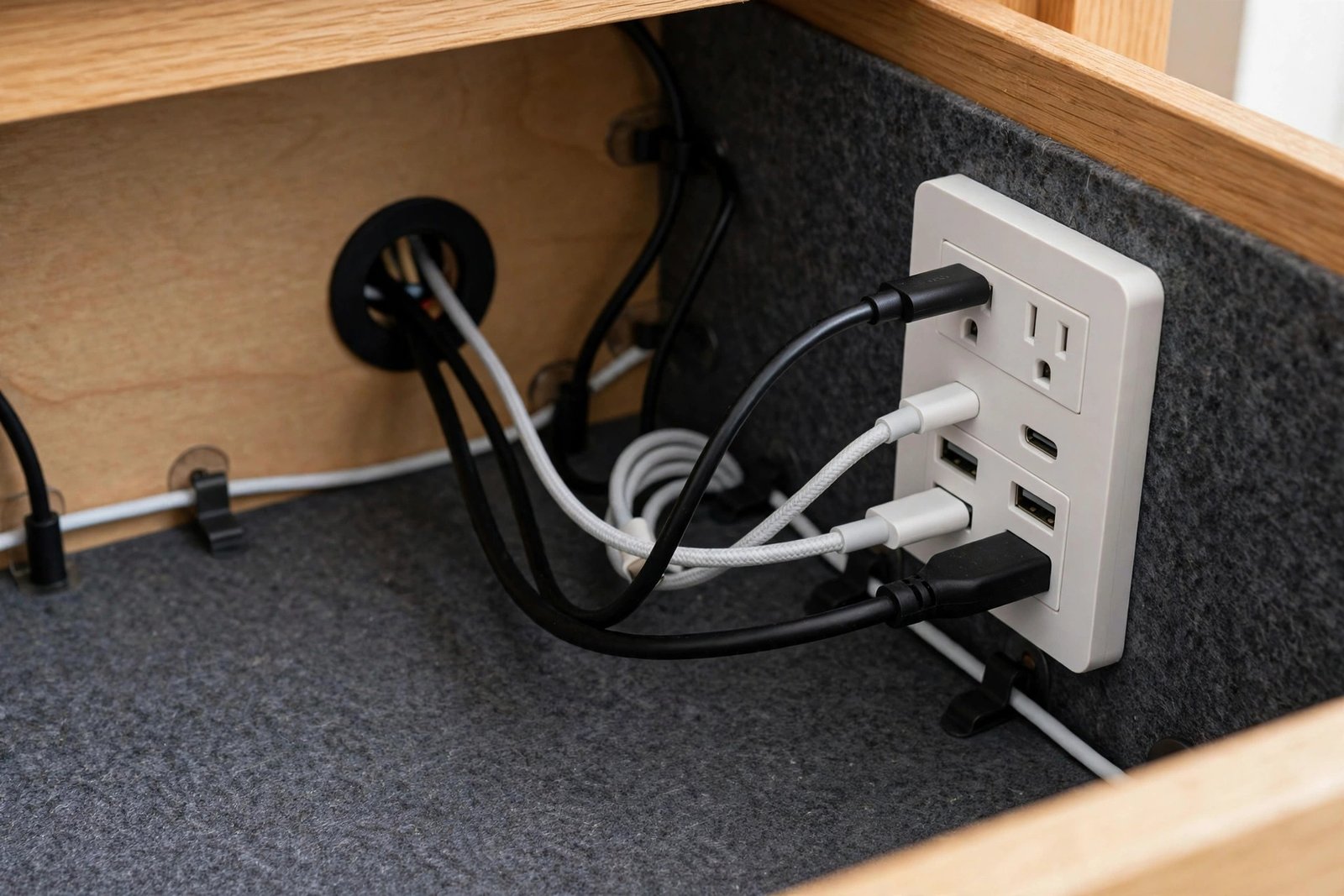
Option 1: A purpose-built in-drawer outlet. This is the route most serious builds use. Units from brands like Docking Drawer mount at the back of the drawer, include cable-management arms so the cord flexes as the drawer slides, and — most importantly — are safety-certified: ETL Listed under UL 962a and CSA C22.2 No. 21, with models compliant with the Canadian Electrical Code. They include a thermostat that cuts power if drawer temperature exceeds 120°F, and are cycle-tested for hundreds of thousands of opens and closes. Pick a model with USB-C ports for phones and tablets, and check the current price on the brand’s site.
Option 2: A regular power strip. Skip this one. A standard strip tossed in a drawer isn’t rated for enclosed spaces, won’t pass inspection, and creates real fire risks — especially if something heat-producing ends up running inside a closed drawer. Purpose-built outlets exist precisely because regular strips fail here.
The golden rule: if a wall outlet already sits near the drawer for the unit to plug into, this is a straightforward install. If there’s no nearby power and you’d need new wiring or a new circuit, that’s electrician territory. Electrical work can also require a permit where you live — check your city or municipality’s rules first, or just ask an electrician.
Step-by-step build checklist
Once the power question is settled, the build is a satisfying few-hours project.
- Pick your drawer. A kitchen junk drawer or nightstand top drawer works best — deep enough for a phone lying flat plus the outlet, with nothing inside that snags.
- Empty and clean it. Pull everything out, and be honest about the junk while you’re at it.
- Confirm your power path. Wall outlet close behind or below the cabinet? You’re good. No nearby outlet? Stop here and call an electrician.
- Mount the outlet at the back of the drawer. Follow the manufacturer’s template and screws exactly — no tape, no hot glue, no improvising.
- Route the cord. Feed it through the back of the drawer and the cabinet to the wall outlet, using the cable-management arm so it flexes instead of pinching.
- Organize the inside. Add a divider tray so each device gets a slot, plus cable clips along the sides to keep cords in their lanes.
- Test with the drawer open first. Plug in one device, confirm it charges, then slide the drawer back and forth several times watching for pulls or pinches. Only then use it day-to-day.

The safety rules that actually matter
A charger inside a closed drawer sits in a wooden box surrounded by paper, cords, and lint. Take these seriously:
- Only use outlets designed and listed for in-drawer use. Standard power strips aren’t rated for enclosed spaces.
- Respect the heat. Never stack devices on their charging bricks, never pile clothes or paper over charging devices, and if anything ever feels unusually hot, unplug it. Certified units cut power above 120°F — that’s your backup, not your plan.
- Keep it to low-power charging. Phones, tablets, watches, earbuds. Don’t charge power tools, space heaters, or other high-draw items inside a drawer.
- Don’t overload. Respect the unit’s amp and watt ratings.
- Check on it periodically. Open the drawer while devices are charging and look for frayed cords, scorch marks, or a warm plastic smell — all mean stop until a professional looks at it.
- Renters: clear anything involving drilling or wiring with your landlord.
When to call an electrician (no shame in it)
Call a licensed electrician if: there’s no wall outlet near the drawer, the project needs new wiring or a circuit, you’re unsure whether a permit is needed, your home has old wiring (knob-and-tube, aluminum, or cloth-insulated), or the whole idea makes you uneasy. A simple outlet addition is usually a quick job for a professional.
Bottom line
The hidden charging drawer earns its trend status: decluttered counters, devices with a proper home, and a phone that can’t wave at you from the nightstand at midnight. The DIY part — mounting, routing, organizing — is genuinely beginner-friendly. The electrical part is where you follow the rules: certified in-drawer outlet only, no improvised power strips, low-power devices only, and an electrician for anything involving real wiring. Do the safety part right and the fun part is the best kind of weekend project — one you use every single day.